Showing posts with label MERCHANDISING. Show all posts

Saturday, 26 June 2021

Stitch Classification - Various Types Stitches Used in Garment Making

 In textiles, a stitch is a series of repetitive single turn or loop of threads or yarns through interloping, intra-looping, or interlacing. It is the fundamental element for sewing, knitting, embroidery, crochet, and needle lace-making whether by hand or machine. It can be formed by any of the following three methods:

  • Interloping: It is formed by passing the loop of one thread through the loop of another sewing thread. E.g. Stitch type 401
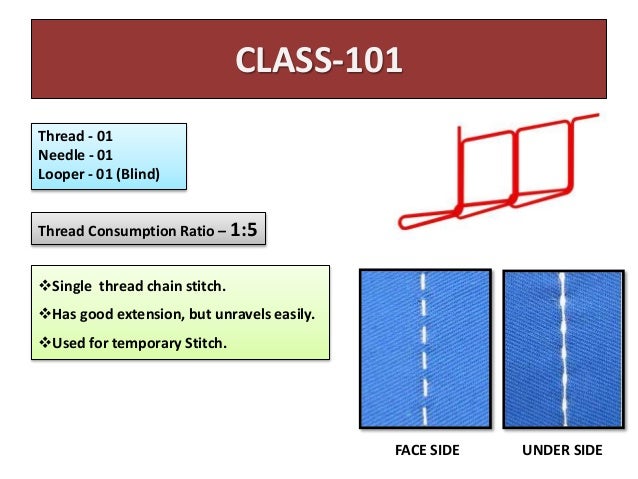
  • Intra-looping: It is formed by passing the loop of one thread through the loop of the same thread. E.g. Stitch type 101
  • Interlacing: It is formed when one thread passes over another thread. E.g. Stitch type 301
Based on this, there are more than 70 types of stitches out of which around 18-20 types are used most frequently and for ease of identification all the types have been grouped to 6 classes based on the number of the needle, direction of sewing, the form or shape of the stitch, purpose of the stitch, etc. The 6 classes of stitch are mentioned as: 

1. Class 100: Single Thread Chain stitch

The stitches formed here are from one or more needle by the method of intralooping. Thus, one or more loops of the needle thread are passed through the fabric and secured by looping with the next loop of the same thread after they are passed through the fabric. This type of stitch is very insecure as each loop is dependent on the next loop and a single thread breakage can pull apart the entire stitch.

These look similar to that of lock stitch on the face side with the loops on the back. The added advantage of these loops is that it makes the stitch elastic and thus can be used where the fabric needs a little stretch such as in back neck tape in t-shirts. Also, with easy removal of stitch, it is used in basting operations in tailor-made garments. This kind of stitch is often not preferred for seaming operations but is widely used in multi-needle machines, as temporary stitch and blind stitch. 

Stitch type 101 or single needle chain stitch is the most common of them along with a 103 single thread blind stitch. The front and back of all the other types are given below 
STITCH TYPE & THREAD CONSUMPTION 

2. Class 200: Hand Stitch

These types of stitches are hand stitches that are used for decorative purposes. These are formed by a single sewing thread and the stitch is held by a single line of thread passing from one side to the other side of the fabric. This is mostly used for casual fitting with a simple sewing needle and thread as domestic needs but is also found as topstitch in high-priced garment due to its perfect finish. This can also be done on automatic machines called pick stitch sewing machines but are very slow and are rarely in use. The front and back of all the other types are given below.  
Basic Textile : Features of Stitch class 200 , its Types , Advantage &  Disadvantage and Uses 


3. Class 300: Lock Stitch

Lock stitch is the most common form of stitch in ready-made garments and is formed when the thread or threads are introduced from one side of the material to interlace with thread or threads introduced from the other side of the material. The top thread is called the needle thread and the bottom thread is called the bobbin thread. The interlacing of the threads makes the stitch secure and difficult to unravel makes it the most appropriate for a wide range of seams. Also, lockstitch has adequate strength for most purposes with a correct combination of thread and fabric.
 
The main disadvantages of lock stitch are
  • Limited bobbin thread length makes it necessary for changing of the bobbin from when it gets finished.
  • Multi-needle stitching with many closed space needles is not possible due to limited space for bobbin. So, at most two needles can be used in a lock stitch machine.
  • The interlacing of thread limits the elasticity of the stitch and is unsuitable for edge neatening.
  • It is not suitable for knitted fabric due to lack in elasticity.
Stitch type 301 is the most common type of stitch with uses in joining garment components, top stitching, etc. Also, buttonholing, button attaching, blind stitching falls in this class of stitches. The front and back of all the other types are given below.  
Lockstitch - Wikipedia 


4.Class 400: Multi-thread Chain Stitch

It is a multi-thread chain stitch type where loops formed in one set of sewing thread is passed through the fabric and are held by interloping and interlacing with loops formed by another set of threads called the looper threads. It looks like that of a lock stitch on the front side of the fabric but has a double chain effect created by the looper thread on the backside. Compares to lock stitch, a 2-thread chain stitch is much stronger and since no threads are interlocking with each other within the fabric there are lesser chances of having a puckering in the seam. Another advantage of this is that both the needle and looper thread runs from large cones on the top of the machine unlike that of the limited sewing thread inside bobbin. Also, it runs much faster than that of a lock stitch machine at 8000rpm. 
Stitch type 401 is the most common of them all and is used in sewing jeans and trousers and is also used with over lock as a safety stitch. Stitch type 406,407 are used for joining lace, braid, elastics with the garment. The front and back of all the other types are given below.  
                           This is a 401 chain stitch located on the outside seam of a pair of jeans.  This stitch has a high speed of production, and is more ext… | Chain  stitch, Stitch, Seam 

5. Class 500: Over-edge Chain Stitch

It is mostly known as overlock stitch and is formed by one or more sets of sewing threads with at least one set of thread going around the raw fabric edge. All the stitch in this class has high elasticity which does not unravel on thread breakage. Also, the machines are equipped with a trimming knife to make the edge neat before sewing. The width of the stitch may vary from 3-5mm. Overlock stitches are classified according to the number of threads used for sewing such as 1,2,3,4 or 5 thread stitches. Each of these stitches is different in appearance and their respective benefits are:
  • 1 thread overlock stitches are used for butt-seaming.
  • 2 -3 thread overlock stitches are used as edge neating seam in woven and knitted garments.
  • 4 thread overlock stitch also known as mock safety stitch provide extra strength while retaining flexibility.
  • 5 thread stitch has two needle threads known as safety stitch which forms stronger seam.
Also, the speed of the overlock machine is similar to that of chain stitch machines and can go up to 8000rpm. Stitch Class 504(3 thread overlock) is the most common of all and is used for securing the raw edges of the fabric and for heavy fabric such as denim 514 (4-thread mock safety) is used. This is because 3-thread stitches are prone to seam grinning when the seam is pulled at a right angle to the seam. The front and back of all the other types are given below. Class-500 (Over Edge Stitch) | Types of stitches, Stitch, Edge stitch 
 

6. Class 600: Covering Chain Stitch

It is mostly known as Flat lock stitch and is formed by three sets of sewing thread namely, needle, looper, and spreader. Apart from the needle threads, the other two sets cover the top and bottom part of the stitch. It is the most complicated of all types with up to a total of nine threads including four needles and rest looper and spreader thread. 

These are mostly used for attaching tape, lace, braid, elastic to the knit fabric, etc. It can also be used as a decorative stitch. Stitch type 602 is mostly used for the above functions and hemming in t-shirts. The front and back of the rest are given below.  
Stich n sesm types with description 
 
 
Stitch classification may not be of so much importance when it comes to knowledge but a clear understanding of it is very much important when there is a requirement of identification of stitching to be done in the garment especially in the tech pack. The stitch type then acts as a code at letting the reader know what stitch has to be done over that part of the garment.    


Collected by: Md. Tarikul Islam Jony
Mail:jonytex073@gmail.com
+8801912885383


Sunday, 29 September 2019

Yarn Count conversion chart

Count:

Count is a numerical expression which defines its fineness or coarseness of a yarn/Thread. It also expresses weather the yarn is thick or thin. A definition is given by the textile institute – “Count is a number which indicates the mass per unit length or the length per unit mass of yarn.”

Types of yarn count
Yarn count

     - Indirect system- English, Metric,          Worsted etc.
     - Direct system- Tex, Denier, Lbs/Spindle etc.


Most of us know that how we can calculate English count(Ne) or Tex or denier.If you dont know, just search by "What is count on textile?" on internet & you will find many articles.

So, today I want to discuss about the relation between some direct & indirect system. Some time its happend that you get a order sheet where customer discribe the thread count by "English count". But you want to order the thread count as "tex". In that cases, if you follow my chart given below, you can easily convert the count from one to another.


Example: A COATS Astra thread having 27 tex.Now we convert it to English count(Ne).

Then, Ne= 591/27
               =21.89.
Please make an excell chart as above picture & you can convert count easily form one to another.


Prepared by:Md. Tarikul Islam Jony
Mail:jonytex073@gmail.com
+8801912885383


Monday, 25 July 2016

How to eliminate Fabric Shade Variation in Garments


Shade variation in garments is caused mainly due to fabric problem. Fabrics are dyed in dyeing machine that has a certain capacity of dyeing fabrics at a time. So, where fabrics are dyed in multiple lots, there is chance of having shade variation between different fabric lots if dyeing process is not controlled.

Shade variation in fabric may appear as
  • Within same fabric roll there may be shade variation like 'center to selvage' and 'salvage to salvage'
  • Within same fabric roll length wise shade variation 
  • Shade variation in between fabric rolls

Shade variation in garments (between different components of the same garment) can be controlled if a SOP is set and employees follow that SOP to reduce shade variation in garments. From fabric inspection to garment finishing in each step you have to be pro-active and take action to prevent shade variation in finished garments.


Tips to reduce and control shade variation in garments:

  1. Fabric inspection: Whether it is in-house dyeing or dyed fabric from outside processors, all fabric rolls need to inspect for shade variation. Categorize fabric rolls based on fabric shades.  If there is a wide range of shade variation and fabric shade is out of the standard one, you can reject that lot and sent back rejected to your fabric processors for re-processing.

  1. Preparing Shade band: Develop shade bands and get approval for all shade bands you have in your bulk fabric. Mark shade band no. to each fabric roll / than. Shade bands help in fabric layering and shorting in cutting room.

  1. Communicate with clear information: When you have an order with varied shades of fabrics, information must be shared with cutting department as well as production department. While issuing fabric to cutting, intimate cutting department that fabric has different shades and fabric lots should not be get mixed.

  1. Fabric layering: As advised in point#2, you have to categorize rolls according to shade band. While spreading fabrics for cutting, spread fabrics of same shade band no. in a lay. Don't mix fabrics roll of different shades. When you need to spread fabric of another shade on the same lay place separator to identify cutting of different rolls easily at the time of shorting and bundling. 

  1. Marker placement: In case fabric has shade variation of 'center to selvage' and 'side to side' place garment pattern on the fabric layer in such a way that shade variation would not be prominent (visible) in garment. Like you can set markers as 'one garment one side' and 'side to side' marker

  1. Numbering of layers: Use ply numbering system and number all garment components. Like, all components of a garment should have same sequence number. In case you spread fabrics of multiple lots in a same lay (cut) use separator for each rolls/ lots. Then while you make bundles make separate bundles for each lots/rolls 

  1. Bundle movement in sewing: After following above steps strictly, one even have shade variation in garment if bundles are not maintained in sewing lines. Sewing operators need to close bundles after completing sewing of a bundle. Ensure that when operators join two component they should check ply number on sticker and sew component with same ply numbers.

  1. Replace defective garment part: Check garment component shade variation at the end of line inspection (at the end of sewing process). Garments found with fabric shade variation (varied shade of different components if that is not a design feature) need to be separated from the good garments. Later defective garments (due to shade variation) can be corrected by replacing parts. For the part changing, be careful to cut parts from the matching lots. 

  1. Single piece garment bundling: If you can't stop ply mixing in sewing you can introduce single piece bundle system in production. In this system, there is no way to sew garment components form different fabric plies. I am not suggesting you to change your bundling system but just showing you an option for getting rid off shade variation problem in finished garments. 
Above steps are not difficult to implement in garment production. Try it yourself and share with us how you have improved and handled shade variation issue in your factory.

 Collected By: Md. Tarikul Islam
                         01912885383
                         jonytex073@gmail.com
Sunday, 20 December 2015

Details about Sourcing:::an important part of apparel merchandiser

‘Sourcing is defined as the process of determining how and from where manufactured goods or components will be procured.’ The main motivational force to do sourcing of garments/fabrics is to give the highest level of satisfaction, at low production cost. Today’s business strategy is shifting the certain operations from apparel value chain to low cost and takes competitive advantage to enhance the profit margin.

For garment export house fabric and trims are the raw material which needs to be outsourced. Sourcing is basically determining the most cost efficient vendor of materials, production, or finished goods at the specified quality and service level. It is closely associated and an important part of apparel merchandiser’s responsibility.

Sourcing department along with apparel merchandiser plays the vital role to execute and shipment of export order successfully. Merchandiser must make sure that all approvals related to fabric and trims should be coordinated with the sourcing department in given timeframe. Fabric sourcing department is basically engaged in determining how and where its merchandise i.e. fabric will be obtained within the scheduled time and cost. The different parameters in sourcing i.e. lead time, process of fabric and trim approvals, cost of logistics and incoterms need to keep in mind while deciding the sourcing tactics for particular export order.

Types of sourcing:

Type fabric sourcing

Description

Local manufacturer

Fabric is manufactured locally, with local infrastructure.

Traditional export

Local fabric is exported to garment manufacturing countries.

International sourcing
.

Fabric is made locally, but raw i.e. yarn or fibre is sourced from other country


Global sourcing


Fabrics are made with parts sourced from abroad as part of global sourcing strategy.


Off-shoring

Raw material is exported first i.e. yarn or fibre, then fabric is
reimported to meet the demand.

Global manufacturing    Fabric is manufactured in other country.


Role of production merchandiser in sourcing:
The sourcing and merchandising has the same goal to meet i.e. to get right fabric/trims at right place on right time and with right price. As merchandiser is key person in whole order processing hence sourcing is the integral part of merchandising activities. The role of merchandiser in sourcing can be described as

In small export house merchandiser bares the responsibility of sourcing
In large export houses sourcing team coordinates merchandiser to source the fabric and trims.
Merchandiser is responsible for calculate fabric and trim consumption per garment and coordinate it with sourcing department.
The approvals related to fabric i.e. lab-dips, desk-loom, print-strike-off, dye-lot, thread run, needs to get from buyer within time frame.
The art work, trim card need to get approved from buyer which is responsibility of merchandiser.
To maintain the proper buffer in Time and action calendar is the responsibility of merchandiser.

The process of fabric/trims sourcing
The process of fabric sourcing is very dynamic, it changes with the fabric type, cost quoted by fabric supplier, lead time, buyers requirement. The typical process of fabric sourcing in an export house can be described as:

The material and information flow

The material and information flow in sourcing is from buyer to either to buying house or garment manufacturer. And buying house or garment manufacturer passes this information to fabric and trim supplier. According to information fabric and trim supplier supplies the material to garment manufacturer. Sometimes buyer has nominated supplier for fabrics and trims hence; buyer shares all the information to fabric and trims supplier directly and ask merchandiser to source the fabric and trims as per requirement of order. In this case the all-risk related to fabric and trims i.e. delay, variation, quality checks is transfer to fabric and trim supplier and solely bare by the buyer.

Factors affecting sourcing of fabric and trims

Lead time:

Fabric and trim sourcing is very time consuming process which includes desk loom and lab-dip approvals, trim and art work approval, FPT approval. The fabric sourcing itself will take lead time of 30-60 days depending upon type of fabric for yarn dyed fabric it takes approx.45 day, for piece dyed fabric it take approx. 30 days and for fibre dyed fabric it takes approx.55-60 working days. Merchandiser needs to decide the supplier of the fabric supplier on the basis of type of fabric and time remains in hand to complete the export order. If fabric sourced from other country, then time required for transportation needs to keep in mind.

Trim sourcing is another important factor that needs to take care. For trims generally it takes 30 days to get in-house. That is also depends upon type of trims and from where trims are getting procured.

Logistics:
Logistics is one of the main factors which affects the fabric sourcing drastically. There are several aspects those are 1. Time required for transportation 2. Infrastructure for logistics 3. Cost of logistics. Merchandiser needs to keep in mind these factors while placing the order for fabric or trims. The time required for transportation is very important to achieve the accurate lead time of fabric/trims procurement. Absence of adequate infrastructure will lead to delay in fabric procurement. Cost of logistics will directly affect the cost of garment; hence merchandiser should be well aware about these aspects of logistics and then place the order for fabric and trims.

Quality parameters:
The demand for high-quality low-cost fabric/trims coupled with the need to reduce costs to increase operating profits is driving more companies to outsource manufacturing overseas. Though sourcing is an effective way to do business but sometimes fabric and trims supplier cannot meet the quality parameters, which will lead to trouble for apparel merchandiser to execute the export order.

The ability of sourcing partners to produce quality fabric and trims consistently depends on a number of factors. One of the main factors is skill of the workforce and their worker’s flexibility to work to produce wide range of fabrics and trims. The technology up -gradation of the sourcing partners. Another important factor is the accuracy of written communications and instructions received from the garment manufacturer/ apparel merchandiser.

Sourcing costs:
The sourcing decisions are taken mainly on the basis of cost manufacturing. But now a days garment exporters makes strategic bonding with fabric and trims vendors. The buyers also makes bonding with fabric and trims vendors, these are called nominated vendor. The sourcing cost depends upon following factors
Labour wages
Manufacturing cost
Cost of logistics/transportation
Incoterm negotiated(for international sourcing)
When comparing the costs of manufacturing a fabric and trims offshore or domestically, manufacturers must include all the hidden costs of added processes and steps that go hand in hand with offshore production. The cost of sourcing is optimised when fabric and garment manufacturing units are under one roof or closer to each other. The freight chargers are increased when there delay in manufacturing and material need to send with air freight.

Minimum Order Quantity (MOQ):

This is the important factor that affects the sourcing. For sourcing of fabric and trims there is always a MOQ for which directly affects the cost. Every supplier requires a certain MOQ to produce the fabric and trim economically; otherwise the cost of running the production is higher if production is below MOQ. If garment exporter places the order of raw material below MOQ then generally cost will be more for that. Hence throughout the supply chain MOQ is maintained the in order to achieve the appropriate cost of production.

Types of supplier:

In garment industry suppliers are appointed by export house or by buyer, for the production of fabric and trims. As there are limitations of manufacturing of fabric and trims for garment export houses, though some export houses has in-house fabric production, it has become increasingly common in garment industry to source the fabric and trim from others rather than employing a large production capacity themselves. The main advantage of sourcing the fabric and trim is the transfer of risk and enables the garment exporter to concentrate on only garment production. However, another concerns have been expressed about the prevalence of supplier because of a perception that the exporter has less control over the skills and training of supplier’s employees and so there may be a negative impact on quality and health and safety on site. There are two types of suppliers namely

Nominated supplier
Non nominated supplier

For both type of supplier lead time generally remains same irrespective of MOQ, order quantity, quality parameters of the raw material. Transit lead time will change with the location of the supplier i.e. domestic and overseas supplier.

Nominated supplier:

Nominating the supplier is a common practice in garment industry, a procedure that was initiated by buyers to achieve better control over their supply chain, is now a very common practice followed in the garment export industry and has many aspects to it. These days a buyer nominates suppliers mainly for products like accessories, fabrics, packaging material and logistics to gain better control over their supply chain, get consistent quality and on time deliveries. The most important factor is the standardization of the product as, by nominating suppliers, buyers intended to get raw materials which is having consistent quality and with no defects or flaws. The second important reason for nomination is on time deliveries as buyers were getting delayed orders and most of the times agents/manufacturers blamed suppliers of trims, accessories or fabrics for the delays.

Advantages of nominated supplier:

Time saving for garment manufacturer because they only have to deal with one company to provide basic raw material.
Quality assurance of the raw materials is consistent and taken care by buyer
Nominated supplier can be involved in product development since they are already having good experience in this field.

Along with these advantages there are certain disadvantages for nomination of suppliers

Nominated Suppliers may become overconfident about their product quality
There may be a Monopoly of supplier in the market
Nomination may leads to unethical practices like corruption by agents and traders
Loss of price competitiveness as suppliers sometimes overcharge

Non-nominated supplier:
Non nominated suppliers are the garment manufactures source of raw material.  Sometime buyers provide the specification of the raw materials and ask garment manufacturer to source the same their own suppliers. Non nominated supplier has their own advantages and dis advantages.

As they have challenge to sustain in business, hence non nominated supplier try their best to follow the instructions given by buyer or garment manufacturer
 The cost is competitive to market, which makes them advantageous
Garment exporter may get chance to explore with the innovative products offer by non-nominated supplier.

The disadvantages of these suppliers are

There may be flaws in quality of the raw material due to communication gap between buyer and supplier.
To get involved these suppliers in product development process is difficult task.
It will be difficult for buyer to control the social compliance and ethical business practice norms on these suppliers effectively.

Ordering specifications:

Garment exporter must give specifications to the supplier to get the accurate raw material. The ordering specifications are as

Raw material
Ordering specification

Fabric
§  Fabric design (desk-loom)
§  Fabric swatch(if provided by buyer)
§  Lab-dip/colour standard
§  GSM (Gauge in case of knitted)
§  Yarn count
§  Cuttable fabric width
§  EPI/PPI
§  Fabric finish
§  Requirements of dyes and finishing chemicals
§  Unit of measurement i.e. meter/ yard for woven and KG for knitted
§  Order quantity
§  Shrinkage tolerance
§  Fastness properties

Buttons
§  Raw material i.e. wood, nylon etc.
§  Colour (sample provided by buyer)
§  Unit of measurement I.e. linge
§  Order quantity
§  Quality parameters
§  Button strength
§  Colour fastness
§  Order quantity

Zippers
§  Raw material i.e. metal, nylon
§  Colour
§  Length
§  Type of puller
§  Zipper finish
§  Fastness properties
§  Zipper strength requirements

Thread
§  Colour I.e. thread run
§  Thread specifications i.e. 2 ply, 3 ply
§  Fibre type i.e. filament yarn, or staple yarn
§  Thread ticket no. (thread count)
§  No. of cones
§  Meter of thread content on cone i.e. 1000, 5000 meter.
§  Finish
§  Thread construction
§  Fastness properties
§  Strength
§  Heat sensitivity

Label
§  Type of label i.e. printed, jacquard
§  Design specification of label
§  Size specification of label
§  Colour combination
§  Font type
§  Font size
§  Line spacing
§  Care Instructionstype
§  Fastness properties
§  Dimensions of the label

Polybag
§  Polybag Thickness
§  Raw material specification i.e. polyethylene. Polypropylene etc.
§  Colour
§  Dimensions
§  Specification of Print on polybag
§  Type of closure
§  Type of dents

Cartons
§  No of plies i.e. 3,7
§  Raw material
§  Dimensions
§  GSM of the paper
§  Print specification of cartons
§  Type of carton
§  Dimension tolerance
§  Bursting strength

Interlining
§  Fibre content
§  Construction specification i.e. woven/non-woven
§  GSM
§  Colour
§  Fastness properties
§  Fusible /non-fusible
§  Shrinkage

Approximate Lead time requirement for domestic and overseas sourcing

Article   Domestic sourcing           Overseas sourcing
Fabric (solid dyed)           30 days 45 days
Fabric (y/d dyed)             45-60 days           55-70 days
Fabric (fibre dyed)           75-90 days           90-120 days
Buttons                10-15 days           20-25 days
Zipper   7-10 days             10-15 days
Thread  7-15 days             -
Label     7-15 days             20-25 days
Poly bag               7-10 days             -
Cartons 7-10 days       
      -

These lead time are depends upon the quantity and considering the ideal condition. In any emergency case supplier can also supply the fabric is less duration.
Prepared By: Md. Tarikul Islam
                        01912885383
                         jonytex073@gmail.com